Anglo-Saxon Romsey
The Evidence in the Landscape
Paulet St John & his Family

The parish register for Farley Chamberlayne recorded the birth and baptism of Paulet St John, son of Ellis St John and his wife Martha - born on the 7th of April 1704 and baptised on the 27th.

The church of Farley Chamberlayne

Paulet St John’s grandfather and father - Ellis Mews & Ellis Mews St John

The Coat of Arms of Ellis Mewes hangs in the Court Room in Romsey Town Hall. It is one of the 13 framed paintings of arms that had originally been displayed in the earlier town hall located in the Market Place next to Broadbridge.

Romsey's first Town Hall. The Fishlake flows through the gap between the buildings, hidden by a stone screen.

Ellis Mews married Christian St John in Farley church on 4 October 1666. She was the daughter and heir of Oliver St John, Lord of Farley Chamberlayne.

Christian Mews, Paulet St John’s grandmother, was buried in Winchester Cathedral on 12 February 1680/81.

The will of Ellis Mews:
In the name of God, Amen I Ellis Mews of the City of Winchester Esqr being in good health and willing to settle my little Estate in peace, First I give to my Sonne Ellis St John Esqr Five Shillings— I give my House & Gardens unto my loving Wife Joane for the Terme of Twenty Yeares To comence at the Tyme of my Death; And I doe make my Daughter Elizabeth Mews my Executrix to enable hir to pay my Debts And doe hereby revoke all former Wills by me made In Wittnesse whereof I have hereunto sett my hand & seale the first day of Aprill 1709.

The burial of Ellis Mews on 26 June 1709 was recorded in the register of the church of St Thomas. The burial took place in Winchester Cathedral.


The graves of Ellis Mews and his wife Christian St John Mews are in the south aisle of Winchester Cathedral. The inscriptions on the slabs have been worn down through the centuries.
Ellis Mews St John

Oliver St John, the brother of Christian St John Mews, is buried along with his wife Margery in Farley Chamberlayne church. The frame around the slab gives details of her life. Margery was the daughter of Francis Rivet of Kings Somborne. She died in 1681, at the age of 39, leaving 3 daughters - Elizabeth, Frances, and Margery - and a son, Oliver. Oliver died unmarried in 1699, aged 20. His sister Frances St John married her first cousin Ellis Mews.

In the Farley parish burial register, Oliver St John is described as ‘Lord of this Manor and Patron of this church’.
The marriage settlement between Ellis Mews and Frances St John is held in the Hampshire Record Office. The document, written on parchment, is dated November 1699.

The marriage of Ellis Mews to Frances St John was recorded for 6 December 1699 in the Farley parish register.


Frances St John married Ellis Mews in December 1699 and died slightly over a year later, in March 1700/01 - the change in the calendar to begin a new year on the 1st of January did not take place until 1752. After he was married, Ellis changed his surname, by act of Parliament, from Mews to St John. Frances and Ellis did not have any children.

Frances was buried in Farley Chamberlayne church in March 1700/1701. The infant twins of her sister Margery had been buried the previous month and a daughter named after her mother had been buried in 1698. Margery was the wife of Walter Godfrey of Lee. She died in April 1703.

Ellis St John’s second marriage was to Martha Goodyer of Dogmersfield, recorded in the church Marriages Register on 31 January 1702/3.

A marriage settlement document was drawn up prior to Ellis and Martha’s marriage. It was witnessed by Martha’s brother John Goodyer. He died unmarried in 1712, and the ownership of the Dogmersfield estate passed to their mother, Hester. On her death in 1723, Martha Goodyer St John became the sole heir.

The Farley church register recorded the births and baptisms of Ellis and Martha’s children - Paulet in 1704, Ellis in 1705, a daughter Esther (or Hester) in 1707 and John in 1712.

Two additional births were recorded in the Dogmersfield register - Edward in 1714/15 and Goodyer in 1718/19. Ellis and Martha’s third son, John, died in April 1719. He would have been 6 years old. Goodyer wasn’t mentioned in Ellis St John’s will written in 1728, so it is likely that he had died by that date.

Martha St John was buried at Dogmersfield in March 1724/25. The the previous entry in the Burial Register was for her mother Hester Goodyer in February 1722/23.

Ellis St John was buried on the 24th of January 1728/29.
In his will Ellis St John stated: ‘First and principally I commend my Soule to God my Body to the earth to be decently interred in the vault att Dogmersfield’. He was buried at Dogmersfield on 24 January 1728/9.
The will made provisions for Ellis and Martha’s surviving children: ‘as for my temporall Estate I dispose of the same as followeth
Whereas by a marriage settlement made by me on the marriage of my late wife Martha the Mannors
of Farley Littleton Shoddesden Hannington and premises with the Lands and Tenements thereunto
respectively belonging are charged with the payment of a certaine summe of money to and amongst
the younger Children of my said late wife Martha by me begotten.’
Hester was to receive a yearly annuity of £300 until her marriage and £7250 on her marriage.
Edward’s annuity was to be £100 up the age of 17, £150 to the age of 21 rising to £200 at 23, along with a lump sum of £6250. Edward was also bequeathed ‘all that my messuage or tenement backside garden orchard and premises thereunto belonging being part freehold and part leasehold situate lying and being in the High Street in the City of Winchester’.
Ellis received ‘all my goods and furniture in my house or outhouses at Finchamstead’ and the rents from other properties and woodland in the parishes of Arborfield and Barkham, south of Reading.
Paulet St John, the eldest son, was to have the rest of his father’s property and possessions. The two executors of the will were to be responsible for ‘the care management Education Tuition Guardianship and breeding up of my two younger sons Edward and Ellis’. The executors were Paulet St John and William Pescod. The will was written in 1728, a year after William Pescod’s marriage to Jane Harris. Following William’s death in 1760, Paulet St John married his widow, Jane Pescod.
Paulet St John’s Children
Paulet St John had been married and widowed twice before he married Jane Pescod. On 17 August 1731, he married Elizabeth Rushout in St Mary’s Church in Marylebone. She was the daughter of Sir James Rushout of Northwick Park, Worcestershire and Arabella Vernon, daughter of Sir Thomas Vernon, a director of the East India Company and MP for the City of London. Both parents died in 1705 when she was an infant. The church marriage register gives Elizabeth’s address as St George Hanover Square, a very fashionable part of London. She was probably living with her father’s brother Sir John Rushout, a Whig politician and MP for Malmesbury and Evesham. He was mentioned in the couple’s marriage settlement, along with Richard Lockwood of London, a Tory MP.
Elizabeth died in December 1733 and was buried In Dogmersfield church. A report of her death in the Gloucester Journal stated that she was ‘in the 30th Year of her Age’. It described her as the ‘Sole heiress of Sir John Rushout, Bart.’ - a mistake in the forename, John rather than James. Elizabeth and Paulet had no children.


Paulet St John’s second marriage was to Mary Tynte, the daughter of John Waters of Brecknock, Brecon and the widow of Sir Haswell Tynte of Goathurst in Somerset. Mary was married to Sir Haswell in September 1727. A daughter Jane born the following year died at the age of six months. A second daughter, Mary, died in February 1732/33; her father had died in November 1730.

The Goathurst parish register recorded the birth of Jane Tynte, daughter of Sir Haswell Tynte and Lady Mary, in October 1728 and her burial in April 1729. When their daughter Mary was buried three years later, Lady Mary was a widow.
Paulet St John and Mary Tynte were married in September 1736.

The births and baptisms of Paulet St John and Lady Mary’s seven children were recorded in the Dogmersfield parish register. Henry Paulet was born in 1737, followed by Ellis in 1739, John in 1740, Mary in 1742, Oliver in 1743, Edward in 1744 and William in 1749.

The Dogmersfield register also recorded the burials of three of Paulet and Mary St John’s children. Oliver was only two months old when he died in October 1743. Ellis died four years later, age 8. His brother Edward lived to the age of 12. With his death in December 1756, his mother would have buried five of her nine children - her two daughters born during her first marriage and three of her six sons.
Paulet St John wrote his will in February 1777 and later added several codicils, the last two weeks before his death in June 1780. He left bequests to each of his four surviving children. As would be expected, the bulk of his estates went to his eldest son Henry Paulet St John. If Henry and his son, also named Henry Paulet St John (later to add Mildmay to his surname), both died without issue, the estates were to pass to the next eldest son, John. William was given the manor of Hartley Whitney and the property in Kings Somborne that had been purchased from Sir Danvers Osborne. The sum of £10,000 was divided equally between the three younger children, John, William and Mary. This payment was made under the terms of the marriage settlement drawn up in 1736, prior to the marriage of Paulet St John and Mary Tynte. The two sons were left an additional £1666, 16 shillings and 8 pence by their father to make a total of £5000.
In 1777 Mary St John was 35 years old and single. Her father provided her with the means to live independently: ‘And whereas my daughter Mary St John will be entitled as a younger child under my settlement to the Sum of £3333, 6 shillings and 8 pence I give her as an Addition to her fortune One Annuity of £186 13 shillings for and during her natural Life payable to her sole and separate use independent of any Husband she may have.’ The annuity would have had the buying power of about £40,000 in today’s money. Mary died unmarried in 1802. The ‘Sum of £4666 and 13 shillings and 4 pence to be paid to such Child or Children as may be living at her Death’ would have passed to her eldest brother, Henry.
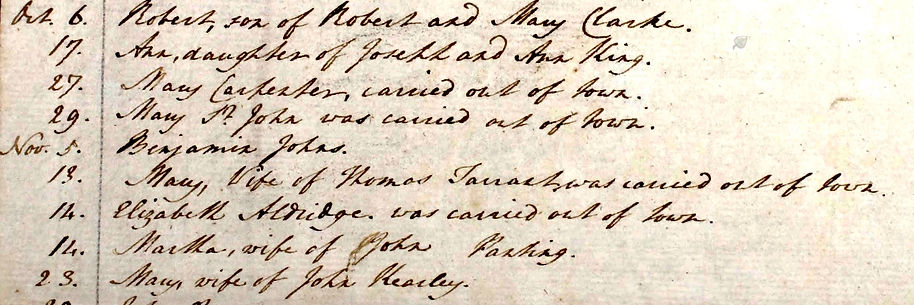
The burial records of All Saints Church in Southampton include a notice for Mary St John, dated 29 October 1802 - she was ‘carried out of town’. Her burial in Farley Chamberlayne took place on the 12th of November.
Several months before his death, Paulet St John added a codicil to his will regarding his bequests to his son John:
‘A Codicil to be annexed to him as part of the last Will and Testament of me Sir Paulet St John Baronet the 15th day of March 1780 Whereas I have given in the former part of this my Will annexed unto my Son the Reverend John St John the Sum of £1666.16 shillings and 8 pence as an Addition to his Fortune by my Settlement which with the Sum of £3333. 3 shillings and 4 pence being his proportion of £10,000 contained therein as a Settlement on my Younger Children which will make up the Sum of £5000 and having reason to think that by his imprudent Conduct he has contracted Several Debts which he was and is unable to pay and that Sir Henry Paulet St John has advanced him £2000 and upwards and as a Security to pay the Interest of the Same the said John St John has assigned over to Sir Henry Paulet St John the Rectory of Farley and being likewise informed that he is indebted unto my Son the Reverend William St John in the Sum of £700 and to pay the Interest for the same has assigned over the Profits of the Vicarage of Hartley Whitney And knowing that my Son John St John is apt to imbibe suspicious and litigious sentiments therefore if he should litigate the said Accounts which I presume will be just I do revoke the said Sum therein given of £1666 16 shillings and 8 pence and is not to stand a part of my said Will.’
Hopefully, the threat of the loss of a substantial sum of money will have deterred him from challenging the assessment of the repayments owed to his brothers. The Reverend John St John died in 1786.

The Hampshire Record Office catalogue entry for a document regarding the repayment of John St John’s debt to his brother Sir Henry Paulet St John.
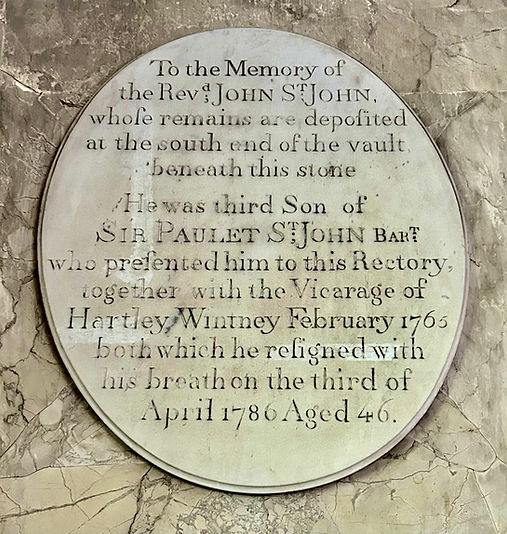
Monument to John St John in Farley Chamberlayne church.
Paulet St John made the following bequests in the final codicil to his will:
I Request that £100 may be given to My Wife to be disposed of by her among those of my Servants that she thinks most deserving Vid. Edward Morrell £20 Letitia Hoar £20 Mary Bird £10 Susanna Carden £5 Jacob Strong £5 Joseph Shores £5 I mention these Persons the remaining £35 I desire she will dispose of either among the above Persons I have named or to such as she may think intitled to for their faithful Services
May 27th 1780
The following obituary appeared in the Hampshire Chronicle:
WINCHESTER, Saturday, June 10.
On Friday evening died, aged 76, Sir Paulet St. John, Bart. truly lamented by all who were acquainted with him. He was formerly one of the members for this city, and High Sheriff and Knight of the Shire for the county of Hants. Every department in which he served was discharged with integrity and honour. In his private character he was ever free from censure; a virtue worthy of imitation. He acted as a magistrate for this county fifty years, and though he never relaxed the discipline of the laws, he was no less tender and humane in the execution of them.
He is succeeded in his honour of Baronet, by his son Sir H. P. St. John, one of the Knights of the Shire for this county.